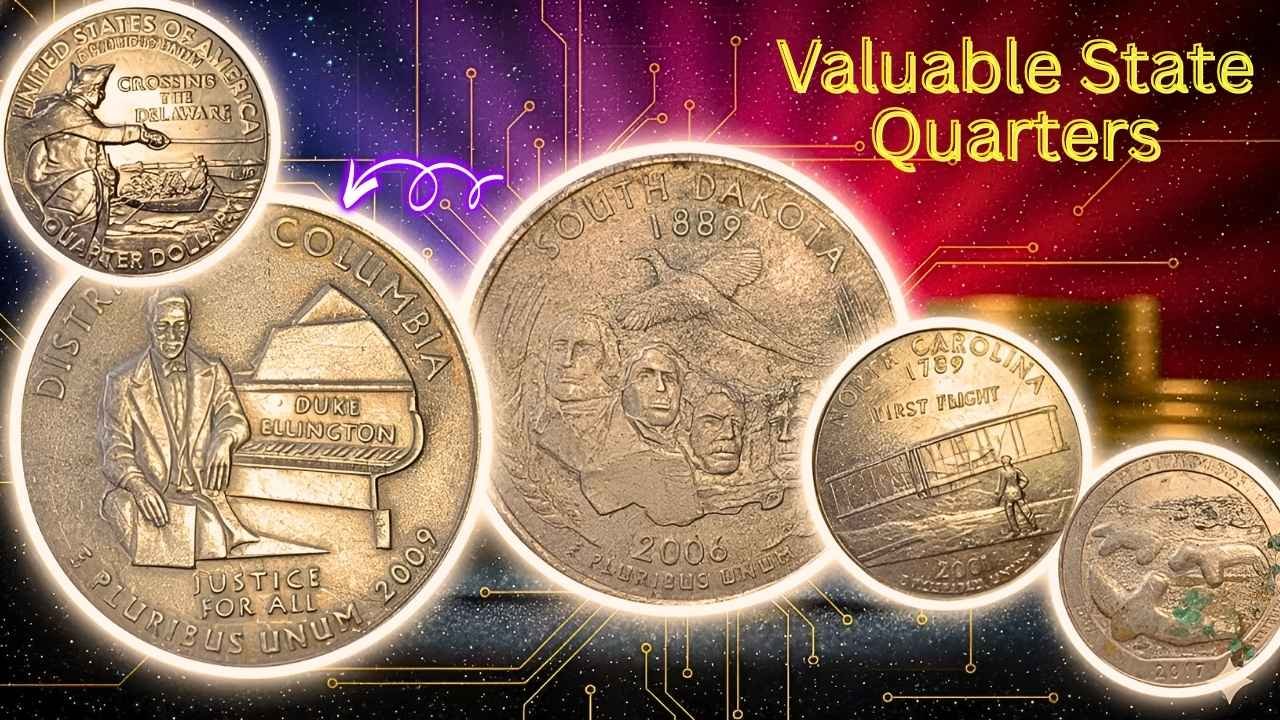
The U.S. State Quarters program changed the way Americans looked at spare change. Introduced in 1999, this program released quarters honoring each of the 50 states, and millions of people began collecting them almost overnight. While most state quarters are still worth only 25 cents, a small number have become surprisingly valuable. These rare coins often feature minting errors, limited production runs, or exceptional condition. Many of them are still in circulation today, which means you could already own one without realizing it. Below are the top five most valuable state quarters in America that are worth checking right now.
The 1999 Delaware State Quarter
The Delaware state quarter was the first coin released under the State Quarters program, making it historically significant. The design features Caesar Rodney riding on horseback, symbolizing Delaware’s role as the first state to ratify the Constitution. Because it was the first issue, it was heavily collected, but certain rare varieties stand out.
One of the most famous errors on this coin is the spitting horse variety. A raised line appears to come out of the horse’s mouth, giving the illusion that the horse is spitting. This error was caused by a die flaw and can be worth hundreds of dollars, especially in high mint-state grades. Other valuable examples include off-center strikes and coins struck on the wrong planchet. Collectors are willing to pay premium prices for well-preserved Delaware quarters with these unique features.
The 2004 Wisconsin State Quarter
The Wisconsin state quarter is one of the most well-known error coins in modern American coinage. The design shows a cow’s head, a wheel of cheese, and a corn stalk. While the standard coin is common, error versions are highly valuable.
Some Wisconsin quarters were struck with an extra leaf on the corn stalk. There are two main types known as the extra leaf high and extra leaf low varieties. These errors were likely caused by accidental damage to the coin die during production. Depending on condition and clarity, these coins can sell for several hundred dollars, with top-quality examples bringing even more. Many of these coins entered circulation, so they are still occasionally found in everyday change.
The 1999 Georgia State Quarter
The Georgia state quarter features a peach in the center, surrounded by the state outline and oak sprigs. While most examples are common, certain error coins have attracted serious collector interest.
Struck-through grease errors are among the most valuable for this coin. When grease covered parts of the die, sections of the design were left weak or missing. In some cases, parts of the lettering or the state outline appear faint or incomplete. These errors can dramatically affect the coin’s appearance, increasing its desirability. High-grade Georgia quarters from 1999, especially those with visible errors, can sell for impressive amounts at auctions.
The 2005 Minnesota State Quarter
The Minnesota state quarter displays a loon swimming on a lake with trees in the background. This peaceful design hides one of the most fascinating error varieties in the entire series.
Some Minnesota quarters were struck with a doubled die error, resulting in extra trees appearing in the background. There are multiple variations of this error, with some coins showing just a few extra trees and others showing many more. The clearer and more dramatic the doubling, the higher the value. Well-preserved examples of these error coins can sell for hundreds or even thousands of dollars. Because the differences can be subtle, many valuable Minnesota quarters are often overlooked.
The 2008 Alaska State Quarter
The Alaska state quarter features a powerful image of a grizzly bear catching a salmon. While most Alaska quarters are easy to find, certain error coins are highly collectible.
Die crack and cud errors are the most valuable types associated with this coin. These occur when the coin die begins to crack or break, leaving raised lines or blobs of metal on the finished coin. Some Alaska quarters show dramatic die breaks that significantly alter the design. Collectors value these bold and unusual errors, particularly when the rest of the coin remains in good condition. High-grade examples can be worth far more than face value.
Key Highlights
State quarters may look ordinary, but a few are worth serious money. Coins from the early years of the program, especially 1999, tend to be more desirable. Minting errors such as doubled dies, extra design elements, and die cracks are the main drivers of value. Condition also plays a major role, as coins in mint-state condition are far more valuable than worn examples. Careful inspection using a magnifying glass can help identify important details that others might miss.
Final Words
The State Quarters program created one of the most popular coin-collecting movements in American history. While most of these coins remain common, a select few have become valuable treasures hiding in plain sight. Checking your spare change for unusual details could lead to an exciting discovery. Beyond their monetary value, these quarters represent history, craftsmanship, and the thrill of finding something rare. The next time you come across a state quarter, take a closer look. It might be worth far more than you ever imagined.
